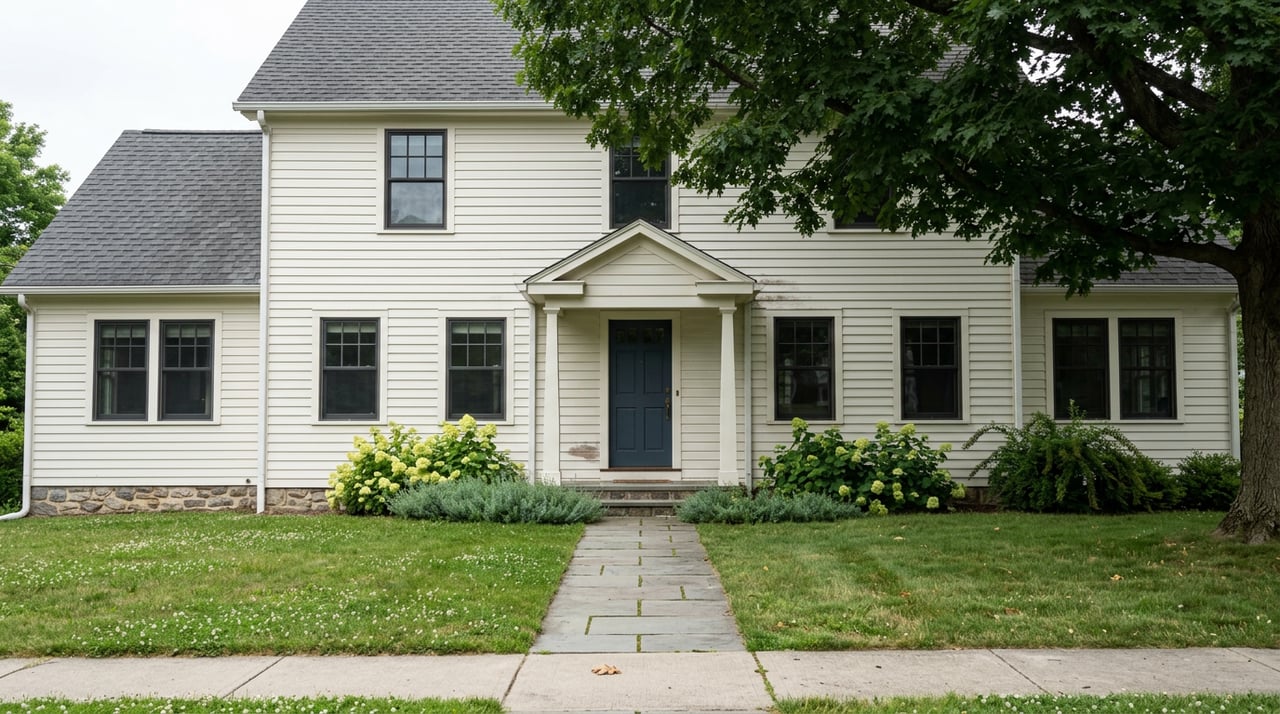
Pull up Churchville, New York on five different real estate sites in the same afternoon and you will get five different answers to a question that sounds like it should have exactly one. One national portal puts the median list price this summer at roughly $499,000. Another, tracking actual closed sales, shows a median of $324,806 as of May 2026, a jump of more than 51 percent from a year earlier. A separate calculator, used by a flat-fee listing service to estimate seller savings, builds its math around a median home price of $263,750. And two brokerage websites drawing from the same regional MLS feed show average asking prices of $480,710 and $571,512, one built from 12 active listings, the other from 9.
None of these numbers is wrong. That is the part worth sitting with if you are comparing Churchville against other Monroe County communities before you decide whether it is worth a closer look. The disagreement is not a data error on anyone's part. It is what happens when you try to compress a housing market this small into a single figure, and understanding why matters more than memorizing any one of those numbers.
The problem is the sample, not the source
Churchville's for-sale inventory at any given moment tends to run in the single digits or low teens. When a market has 200 active listings, one unusual sale barely moves the median. When a market has 9 or 12, one unusual sale is the median. A single custom home on acreage closing well above the norm can pull an average up by tens of thousands of dollars overnight. A single modest ranch closing well below it can pull that same average back down just as fast.
That is the honest explanation for why RE/MAX Plus's own Churchville-area listing feed shows an average of $480,710 across 12 listings while a competing brokerage's feed, working from a smaller pool of 9 listings pulled from the same underlying MLS data, shows $571,512. Neither figure is describing a market. Both are describing whichever handful of houses happened to be listed the week the page loaded.
List-price medians and sold-price medians measure two different things entirely. A list price is what a seller is asking. A sold price is what a buyer actually paid, often after negotiation, sometimes after a bidding war. Treating the two as interchangeable is how a buyer ends up anchored to a number that never reflected an actual transaction.
New supply arrives all at once, and it isn't always for sale
If you want to see how a market this size absorbs new inventory, look at what happened on Buffalo Street. Black Creek Commons, a mixed-use building overlooking Black Creek in the heart of the village, spent nearly eight years working through local approvals. The Village of Churchville's planning board originally approved the conditional use permit in November 2017, then extended that same permit six separate times between September 2018 and March 2021 before the project finally cleared construction and opened in the spring of 2025.
What landed, according to the developer's own listing, was eight two-bedroom apartments with private garages and elevator access, plus two ground-floor retail spaces now occupied by an established insurance company and a property management firm. That is meaningful new activity for a village this size, but it is not new for-sale housing. It added rental units and commercial storefronts to the center of Churchville, not additional single-family inventory to the owner-occupied market.
That distinction matters more than it sounds. It means the tightest part of Churchville's market, the actual for-sale homes competing against each other, hasn't seen meaningful new supply in years. The village's biggest recent development story is a rental and retail project, not a subdivision. If you are watching Churchville hoping new construction will loosen up the for-sale side, the last eight years of local permitting history suggest that relief is not close at hand.
The other end of the market: quarter-acre lots and no town tax
Part of what makes any single Churchville median so unstable is that the housing stock itself splits into two very different products. Homes near the village core sit on tree-lined, quarter-acre lots in a town established in 1808 on farmland. Move a few miles out and lot sizes can stretch to eight acres, with a housing mix that runs from mid-19th-century Colonials to 20th-century ranches to New Traditional-style homes built over the past 25 years.
There is also a tax quirk worth knowing if you are comparing carrying costs across towns. Some properties in the Town of Riga, which surrounds the village, are marketed with no town tax and free refuse pickup, a detail local listings note often enough that it is worth factoring into an all-in monthly comparison rather than judging a home purely on its sale price.
Churchville Park adds another layer to that quarter-acre-versus-eight-acre split. At 742 acres, it includes a golf course, an ice skating rink, a playground, and a boat launch on Black Creek used for kayaking and fishing, the kind of amenity that reads differently depending on whether you are shopping the walkable village core or a rural parcel a short drive from it.
What "balanced" doesn't tell you
That same flat-fee platform's dashboard describes the Churchville market in writing as balanced, favoring neither buyers nor sellers, while its own scoring elsewhere on the page labels overall competitiveness as Very Competitive. The underlying numbers back the second label, not the first. Months of supply sit at 0.5, which is 79 percent below the New York average of 2.4. Homes are selling at 113 percent of list price, well above the statewide average of 98.4 percent. Zero percent of listings had dropped their price at the time the data was pulled, compared to a statewide average of 13.1 percent.
Those are not balanced-market numbers. Half a month of supply and homes routinely closing above asking describe a market where sellers are holding firm and buyers are competing for very little. The "balanced" label likely comes from a broader scoring model that weighs multiple factors, but a buyer reading only the headline label and skipping the underlying figures would walk into Churchville expecting more room to negotiate than the current numbers support.
What this means if you're comparing Churchville to other towns
If you're cross-shopping Churchville against Spencerport, Ontario, or another Monroe or Wayne County community, the headline median is the least useful number on any of these pages. Ask instead whether it's a list-price or sold-price figure, how many listings it's based on, and how recent the window is. A median built from 9 listings tells you almost nothing about what a specific house will cost. A price-per-square-foot trend over several months, even a modest one, tells you more.
It also helps to know which segment of Churchville you're actually looking at before you get attached to a number. A quarter-acre lot near the village center, a Town of Riga property with no town tax, and a newer build on several acres are three different markets wearing one name, and each will move a shared "median" in a different direction depending on which happens to sell that month.
A few questions worth asking before you tour
Is Churchville currently a buyer's market or a seller's market? The underlying supply and pricing data, half a month of inventory, sales closing above asking, almost no price reductions, point to conditions that favor sellers, regardless of how any single dashboard labels the overall market.
Why did the median sale price jump more than 51 percent in a year? With well under a dozen sales typically closing in a given period, a shift in which homes happened to sell, rather than a broad change in value, can move a year-over-year percentage by a wide margin. It's a real number, but it describes a small sample more than a trend.
Does the new building on Buffalo Street affect home values nearby? Black Creek Commons added rental apartments and retail space, not owner-occupied housing stock, so it doesn't directly enter for-sale comps. Its long approval timeline does suggest that new for-sale inventory isn't arriving quickly, which helps explain why the existing homes on the market are holding their value.
Churchville rewards a buyer who looks past the first number a search returns and asks what that number is actually built from. If you're weighing this village against others in Monroe or Wayne County and want someone to walk through what a specific listing's price actually reflects, Lalla Fitzpatrick would be glad to help you sort it out. Let's Connect.
This article is general information, not legal, tax or financial advice. Consult a qualified professional about your situation.